My latest story, “The Passion of St. George,” is now in its final editing stage and will soon be ready for publishing!
I don’t know how long editing will take, but I expect it will be available for purchase on Amazon Kindle before the end of February at the absolute latest.
I must warn you guys, this is by far the darkest story I’ve ever written. “The Passion of St. George” is a twisted tale of a female college student’s dark sexual awakening after she buys a cursed art print.
The story is so twisted and dark, I’m a little worried what people will think of my sanity when I publish it… Nevertheless, I’m excited to share it with my fellow fans of both horror and art!
I’ll post another update when the story becomes available for purchase. Until then, Happy Year of the Rabbit! May you be blessed with good fortune in the coming year!
It’s been quite a while since my last update, so I wanted to fill my readers in on what I’ve been up to and what to expect.
I haven’t published any new stories for the past year or so because I’ve been focusing on my screenwriting. I recently completed my fourth draft of my feature adaption of the Guy de Maupassant short horror story, “The Horla.” I have a profile on Coverfly, and I’ll add a page to this website listing my completed scripts, so look forward to that and be sure to contact me if you see a project that interests you.
However, the main reason I wanted to write this update is to announce that I’ve finally begun work on my first novel. This novel, titled, The Scarlet Hind, is a medieval romance about a peasant who encounters a beautiful and mysterious fae woman in the woods that surround his village. He can’t help but be drawn to her, but he knows fae cannot be trusted. Furthermore, why are powerful men flocking to the village to hunt her down? Can he trust her or is she dangerous?
I’ve been dreaming up this novel for a while, and I’m really excited to move it forward. I’ll keep updating everyone on its progress and on any other projects I’ve started.
Until then, please be sure to review and share my work if you find it’s to your liking. Every click and share from my readers is a precious gift.
Yesterday, I went over the art pieces that Sally mentions by name in her narration in my short story “The Passion of St. George.” Today, I thought I’d say a bit more about some of the artists whose names and styles are featured in the story.
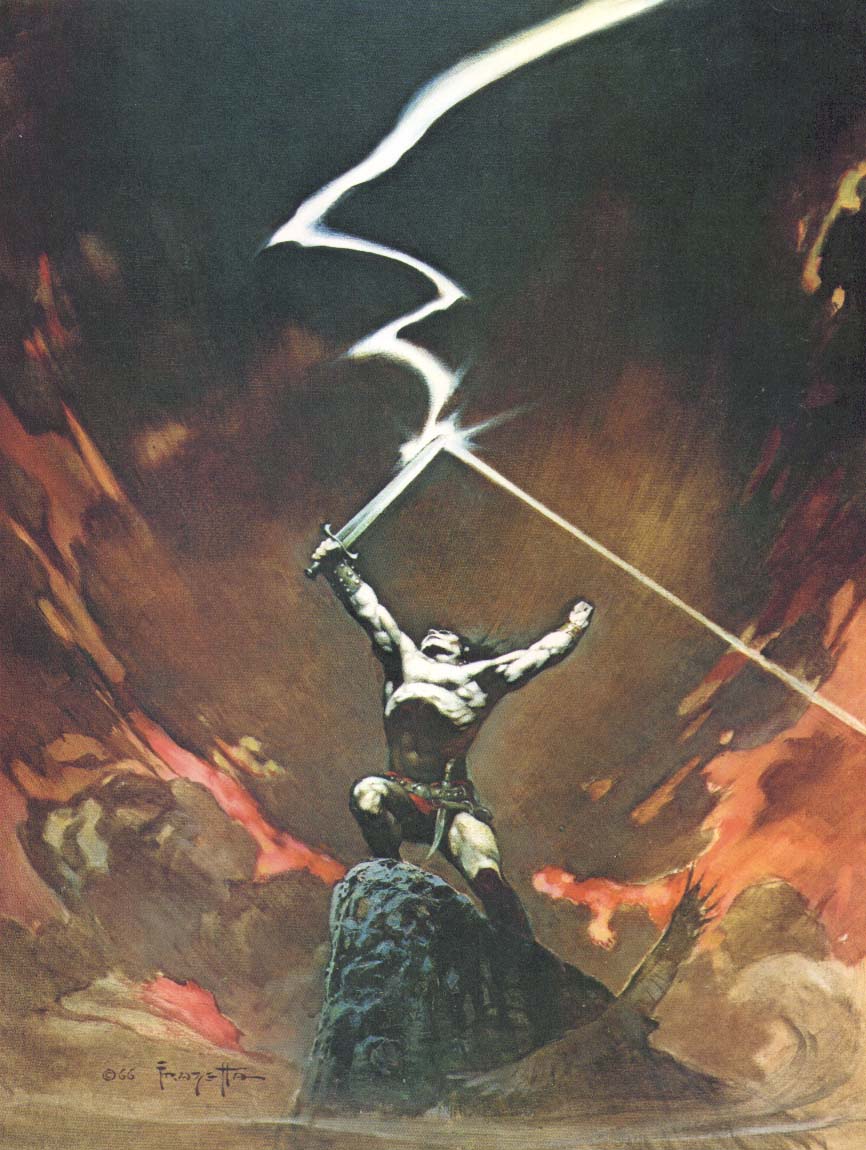
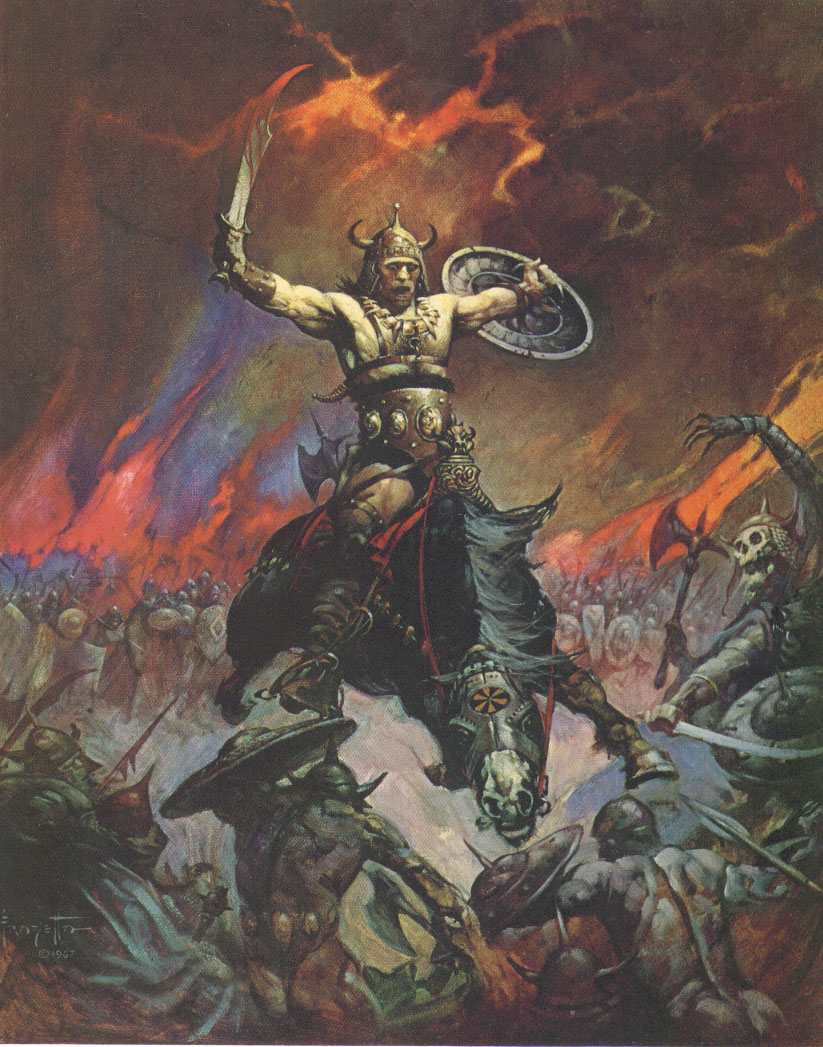
Early on, Sally compares the print of St. George and the dragon she buys to the work of Frank Frazetta , specifically, the covers he painted for the book series Conan the Barbarian.
Frank Frazetta (1928-2010) is a widely celebrated fantasy and sci-fi illustrator who worked in the 20th century. Called the “godfather of fantasy art,” his portfolio includes comic books, book covers, movie posters, album covers, etc., etc. By his own admission, Frazetta never actually read any of the Conan the Barbarian novels. Nevertheless, his style had an enormous influence on the aesthetic of the sword and sorcery genre.
Frazetta’s style is not only by a high degree of contrast between dark and light and a dynamic sense of motion but also by a certain kind of erotic energy. Nudity, both male and female, is common in his work, and even when his subjects are clothed, there is a sort of larger-than-life pathos to the way their bodies are depicted. The body is idealized in its moments of struggle.
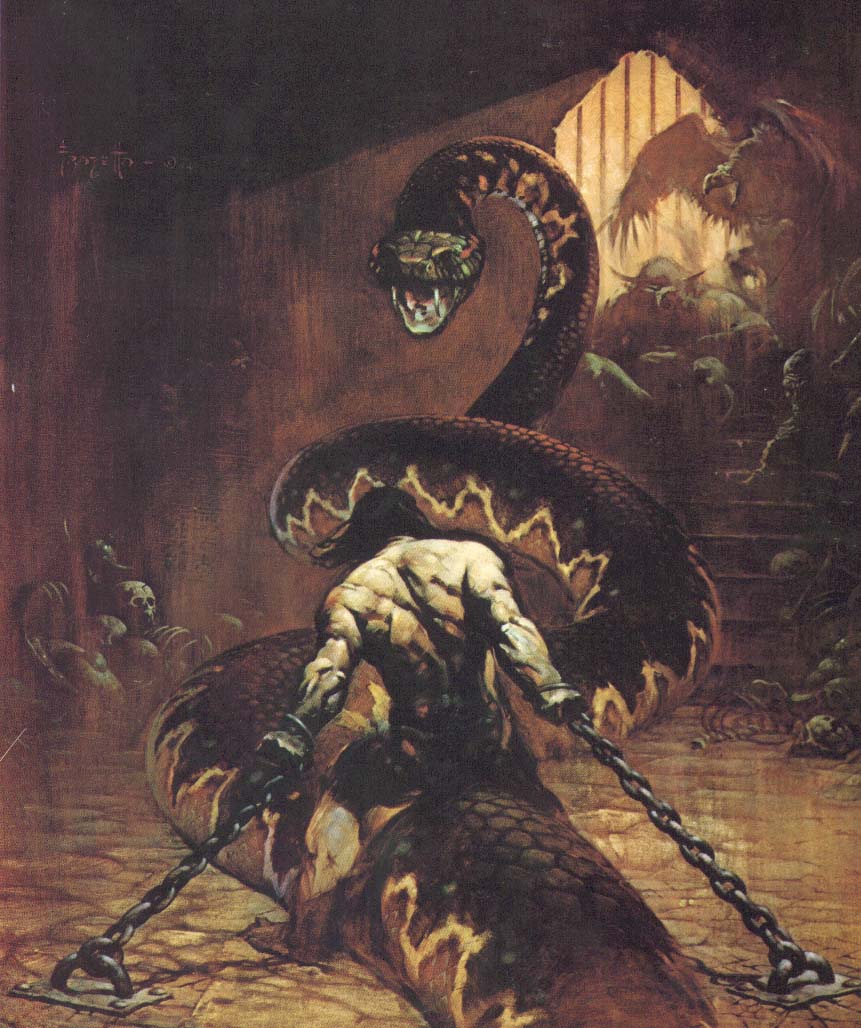
Frazetta’s depictions of heroes battling monsters was an especially strong source of inspiration for “The Passion of St. George,” especially his illustrations of his heroes battling snakes.
If any one single painting of Frank Frazetta’s can be said to have had the biggest influence on “The Passion of St. George,” it would probably be the painting below, simply titled, Serpent. The first time I ever saw this image subject’s pose, the sense of tension between the struggling bodies, and the contours of his exposed flesh all struck me as incredibly erotic.
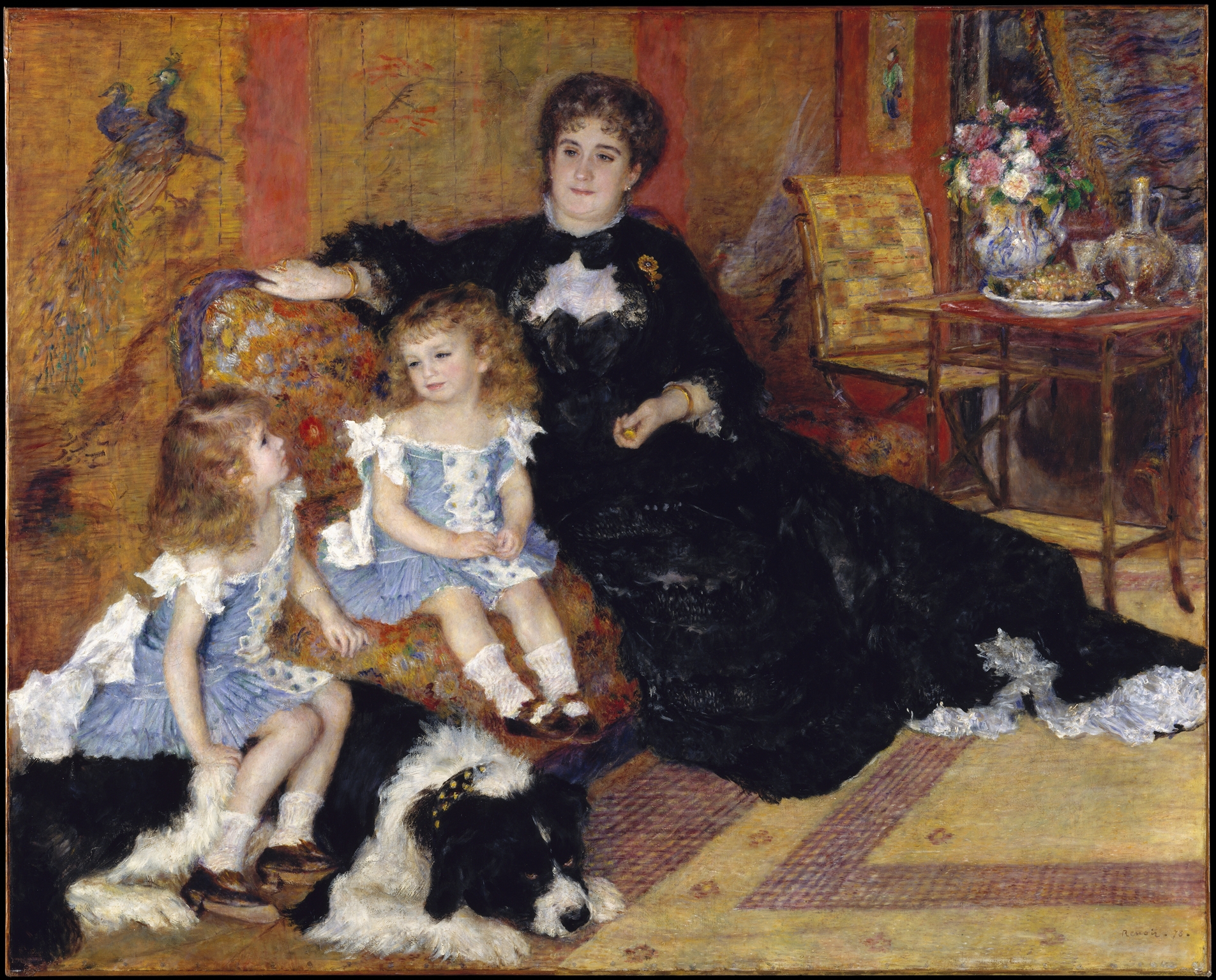
Much later in the story, Sally goes to an art museum and tours the Renoir exhibit that’s currently in town. Pierre-August Renoir (1841-1919) was one of the leading artists of the Impressionist movement, an art style defined by visible brush strokes and emphasis on accurate depictions of light. Impressionist art can be said to be “deliberately flawed” in that it imitates the imperfection of the human eye by incorporating blurriness and haziness in its aesthetic.
Due to the influence of the cursed painting on her mental state, Sally speaks rather dismissively of Renoir despite loving his style in the past. Renoir is a master, of course, but his style is so radically different from the style in Sally’s beloved print of St. George that she comes to view it unfavorably.
Mme. Carpenter and her children, 1878, Metropolitan Museum of Art, New York. Fun Fact: We actually have a copy of this painting hanging on the wall of my family home.Luncheon of the Boating Party, 1880-1881By the Water, 1880, Art Institute of Chicago, Chicago, Illinois
Sally speaks especially disparagingly of Renoir’s nudes, which, though they may not be to her taste, are also very pleasing to look at.
Nude in the Sun, 1875, Musée d’Orsay, ParisSeated Girl, 1883After the Bath, 1888
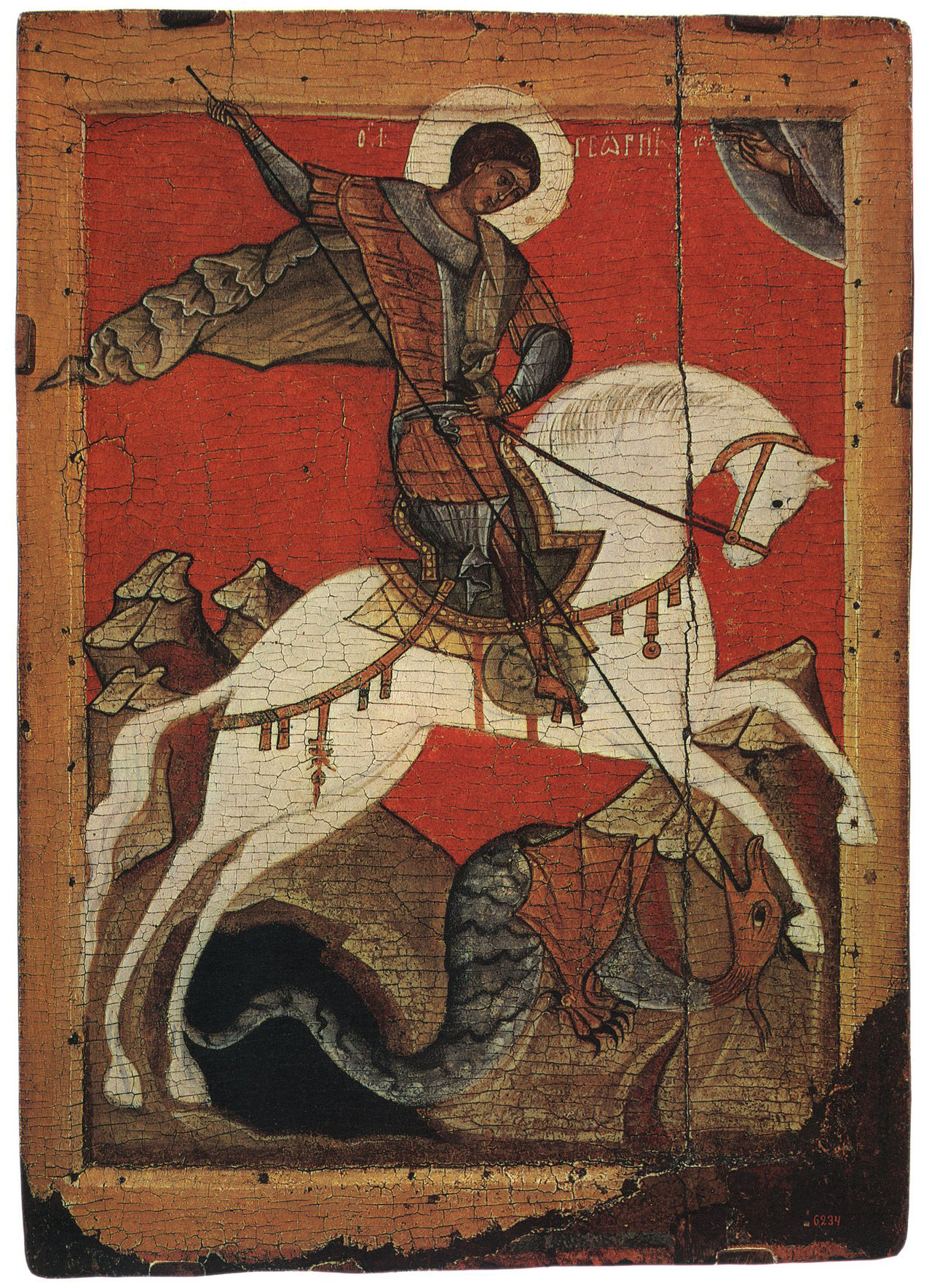
Finally, I want to include some images of the titular St. George himself. As Sally explains in her narration, the medieval legend of St. George slaying the dragon who menaced the Libyan city of Silene has been a recurring motif in art for centuries. St. George is often depicted mounted on his horse as he stabs at the dragon snarling up at him from below.
Novgorod icon, late 15th centuryDe Grey Hours (c. 1400)Bernat Martorell – Saint George Killing the Dragon (1435)
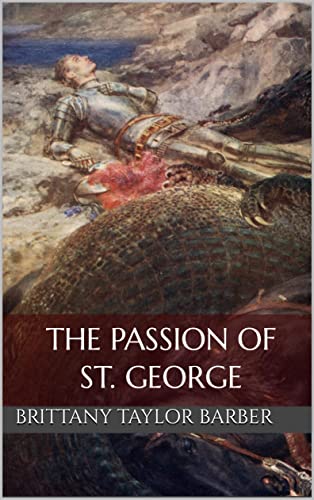
The reason Sally finds the print of St. George in the story so radically different from the norm is because it depicts St. George as weak, exhausted and vulnerable to the dragon. When I wrote “The Passion of St. George,” I didn’t think that any artist had ever painted a St. George like the one in my story, but when I went looking for an image to use for the cover of my story on Amazon, I found this painting by the British artist Briton Rivière (1840-1920), which depicts St. George lying on the ground exhausted after his battle with the dragon.
Briton Rivière – St. George and the Dragon (1914)
When I stumbled across this painting on Wikipedia, I was immediately struck by how similar it was to the print described in my story. True, the horse lying on the ground is black, not white, it still has its head attached, and unlike in Sally’s print, St. George seems to have emerged from the confrontation victorious, but the huge, imposing body of the dragon and the prostate figure of St. George on the ground are eerily similar to the fictional image of the story. This St. George bears little resemblance to the St. George of tradition. Instead of St. George radiant and invincible we see a St. George who’s been pushed to his very limit, a St. George who is not triumphant in his moment of victory but merely relieved, relieved that the deadly struggle is over.
Here, we see of a bit of what Sally admired in her own St. George, a man whose weakness makes him all that much more human.
Classical art is a huge part of the narrative in my story, “The Passion of St. George.” Not only is it an art piece with a mythological subject that instigates the horror and starts the plot, but Sally, the main character, is an art history major and very passionate about art. Because of this, Sally references a lot of real art pieces in her narration. I thought would be a good idea to put together a quick gallery of the art featured in “The Passion of St. George.”
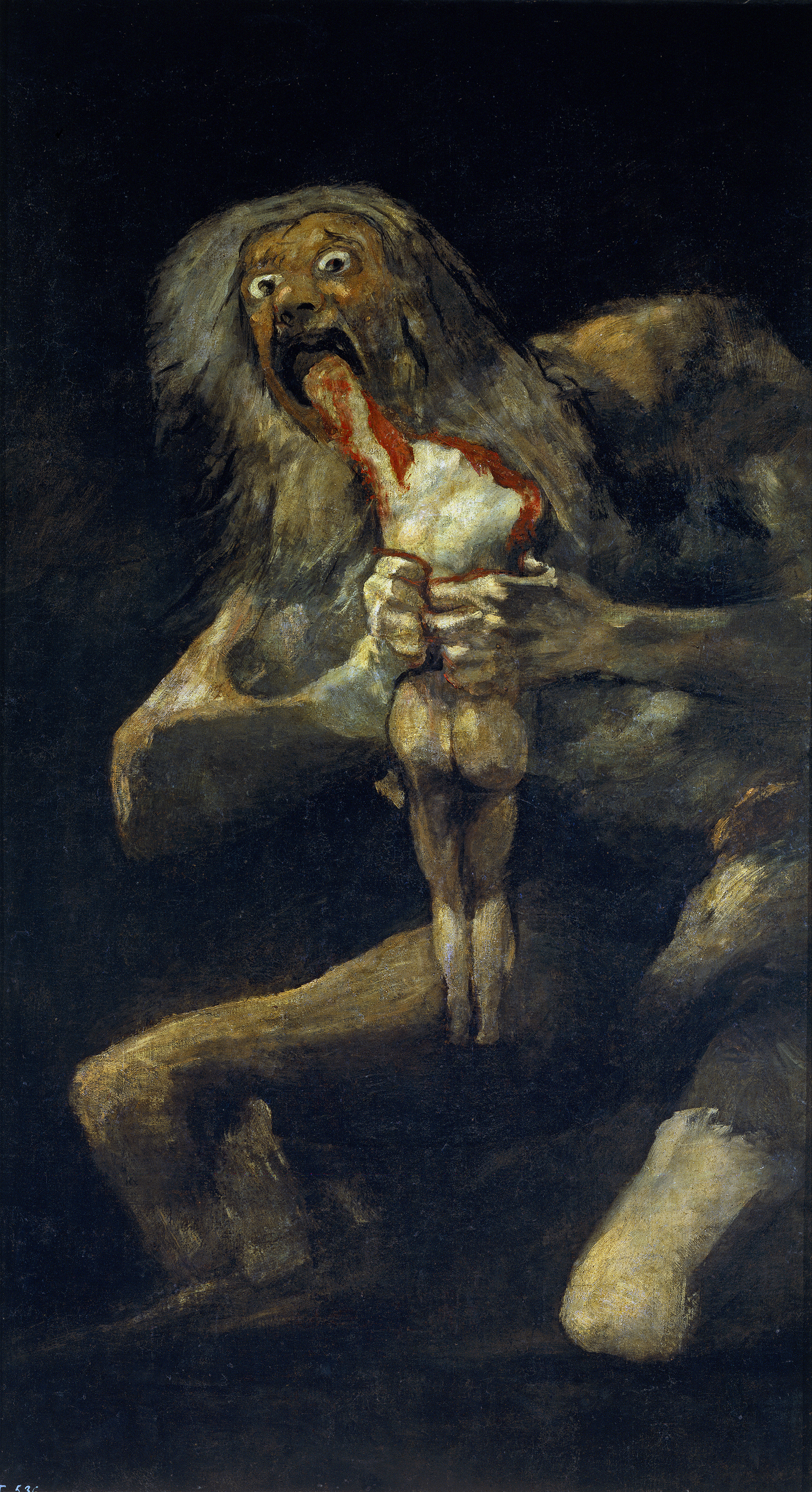
The first painting Sally mentions is Francisco de Goya’s “Saturn Devouring His Son.” This rather disturbing painting is part of de Goya’s series Black Paintings, which were found painted on the walls of de Goya’s home after his death. The series consists of 14 paintings, all of which are known for their disturbing subject matter and bleak perspective.
The next piece Sally mentions in the story is Woman Bitten by a Serpent, sculpted in 1847 by August Clésinger. Sally’s memory of seeing the sculpture at the Musée d’Orsay as a child is based on my own memory of seeing the sculpture when I was fourteen.
Sally names several other famous artworks as she muses on the intersection between artistic depictions of pain and the erotic. The next piece she talks about is Sir John Everett Millais’s painting of Ophelia. Critical reception was mixed when the painting was first exhibited at the Royal Academy in 1852, with some critics taking issue with the artist’s decision to set Ophelia’s death in a rural English landscape instead of somewhere more fittingly beautiful.
Certainly the oldest artwork Sally references in the story is the sculpture Laocoön and His Sons, which was excavated from Rome in 1506. Virgil’s Aeneid describes how the Trojan priest Laocoön and his teenage sons, Antiphantes and Thymbraeus, were strangled by sea serpents sent by goddess Minerva, who was enraged with Laocoön for advising the Trojans against bringing the Trojan horse into Troy and then throwing a spear at it when his advice was not heeded.
Sally’s final example of the strange overlap between the erotic and suffering is William-Adolphe Bouguereau’s 1850 painting Dante and Virgil, which is also on display at the Musée d’Orsay. Though clearly brutal in its violence, a well-circulated post featuring the painting on Tumblr is filled with users giggling at the work’s strangely homoerotic imagery.
In the depths of her obsession, Sally compares the expression on her print of St. George to the expression worn by Holofernes in Artemisia Gentileschi’s painting Judith Slaying Holofernes. Gentileschi actually painted the subject twice in her career. The image below is her second attempt and likely the one Sally had in mind when making the comparison. The painting’s depiction of Judith is speculated to be a self-portrait of Gentilieschi, a decision which may have been motivated by Gentileschi’s experience of being raped by a colleague of her father’s when she was seventeen. According to her own account at her rapist’s trial, Gentileschi brandished a knife at her attacker after he got off of her, saying, “I’d like to kill you with this knife because you have dishonored me.”
After musing for a moment, Sally concludes that the St. George in her print doesn’t really resemble Holofernes after all but instead evokes Teresa of Ávila’s rapturous expression in The Ecstasy of St. Teresa, sculpted by Gian Lorenzo Bernini between 1647-1652. The sculptured was based on Teresa of Ávila’s own account of the religious ecstasy she experienced during her encounter with an angel. The Wikipedia article on the sculpture includes the following excerpt from Teresa of Ávila’s autobiography, The Life of Teresa of Jesus. The sexual overtones of the text are hard to ignore.
“I saw in his hand a long spear of gold, and at the iron’s point there seemed to be a little fire. He appeared to me to be thrusting it at times into my heart, and to pierce my very entrails; when he drew it out, he seemed to draw them out also, and to leave me all on fire with a great love of God. The pain was so great, that it made me moan; and yet so surpassing was the sweetness of this excessive pain, that I could not wish to be rid of it. The soul is satisfied now with nothing less than God. The pain is not bodily, but spiritual; though the body has its share in it. It is a caressing of love so sweet which now takes place between the soul and God, that I pray God of His goodness to make him experience it who may think that I am lying.“
These are the individual pieces that Sally references by name. Tomorrow, I’ll make a post about other artistic influences on the story, including artistic depictions of St. George and the stylistic differences that Sally comes to prefer as the cursed print twists her mind.
I’ve always been fascinated by art, and this story gave me a great opportunity to to dust off my knowledge put it to use narratively.
My latest short story, “The Passion of St. George” is now available for digital purchase through Amazon Kindle!
This is a dark and twisted tale of a horrific sexual awakening brought about by a college sophomore’s growing obsession with a cursed print purchased at an art fair. Told through a series of entries on the main character’s personal blog, this story chronicles the protagonist’s spiral into madness as a result of the transformation wrought by the cursed art.
This is by far the darkest, goriest story I’ve ever written, and it’s definitely not for the faint of heart. I’ve been working on this one since 2022, so I’m super thrilled that it’s finally seeing the light of day!
I’ve also taken the time to update and clean up my Short Stories page here on this site, so as always, don’t forget to check out my other published works if you haven’t already!
Be sure to rate and review this story on Amazon if you liked it or even if you hated it! Every review, positive or negative, helps me grow as a writer.
My latest story, “The Passion of St. George” will be available for purchase on Amazon Kindle later today!
In the meantime, I’ve already created a Tumblr account exclusively for my writing. The Tumblr is brand new, so there isn’t a whole lot of activity yet, but I will be posting updates of my work as well as various posts related to literature and storytelling.
Click here if you’d like to follow me on Tumblr, and keep your eyes peeled for the new story later today!
Progress on my latest story, “The Passion of St. George,” is moving along at a great pace. This one is an erotic horror story about a college girl who buys a cursed print at an art fair…and the terrible urges it awakens in her.
Like with my previous stories, this one will be available for digital purchase on Amazon.
I can’t wait to share it with you guys! Stay tuned for more updates!










 Brittany Taylor Barber